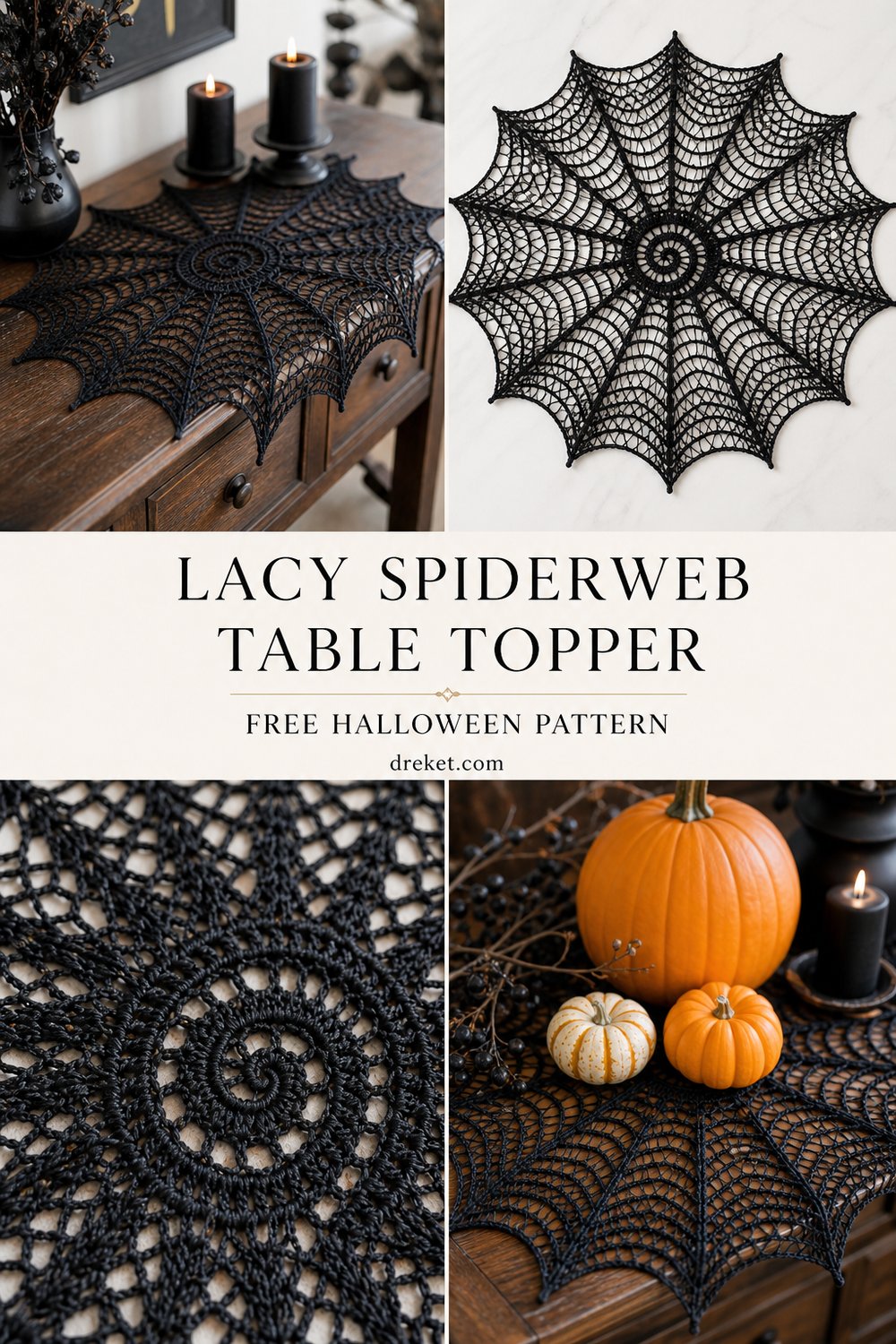


14. Spiderweb Coaster Set
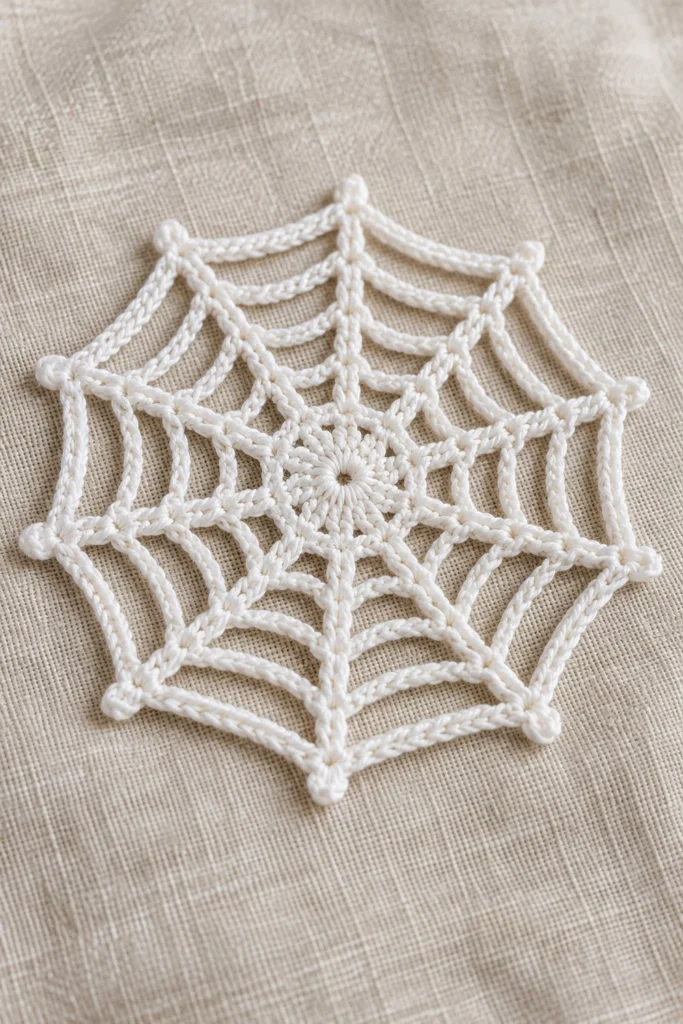
Add a delicate and spooky touch to your seasonal table settings with this charming spiderweb coaster set. Quick to crochet in crisp white cotton, these intricate lace mats protect surfaces while bringing classic haunted house vibes to your autumn decor.
Quick Facts
| Skill level | Finished size | Yarn | Hook | Time |
|---|---|---|---|---|
| Easy | 4 in / 10 cm across | DK cotton (Cat. 3) | 3.5 mm (US E/4) | 30 minutes |
Materials You Will Need
- DK weight 100% cotton yarn in White (approx. 15 grams / 35 metres per coaster)
- 3.5 mm (US E/4) crochet hook
- Tapestry needle for weaving in ends
- Scissors
- Blocking pins and mat (optional but recommended for sharp web points)
Gauge
The first 3 rounds of the coaster should measure approximately 5 cm across. Maintaining consistent, slightly firm tension is more important than achieving exact gauge, ensuring the web arches hold their shape neatly.
Abbreviations (US Terms)
- ch: chain
- sl st: slip stitch
- sc: single crochet
- dc: double crochet
- st(s): stitch(es)
- sp(s): space(s)
- sk: skip
- rep: repeat
UK terms: sc = dc, hdc = htr, dc = tr.
Pattern Notes
- Work in joined rounds unless otherwise specified. Join each round with a slip stitch to the first stitch or chain space as indicated.
- The turning chain-3 counts as a double crochet throughout.
- Stitch counts are shown in brackets at the end of every round.
- Make as many coasters as desired for your set; instructions are for one coaster.
Instructions
Spiderweb Coaster – White, make as desired
Ch 6, sl st to first ch to form a ring.
Rnd 1: Ch 3 (counts as first dc here and throughout), work 15 dc into the ring, sl st to top of beg ch-3 to join (16)
Rnd 2: Ch 4 (counts as 1 dc and 1 ch-1 sp), (dc in next dc, ch 1) 15 times, sl st to 3rd ch of beg ch-4 to join (16 dc, 16 ch-1 sps)
Rnd 3: Sl st into first ch-1 sp, ch 4 (counts as 1 dc and 1 ch-1 sp), (dc in next ch-1 sp, ch 1) 15 times, sl st to 3rd ch of beg ch-4 to join (16 dc, 16 ch-1 sps)
Rnd 4: Sl st into first ch-1 sp, ch 5 (counts as 1 dc and 2 ch-2 sps), (dc in next ch-1 sp, ch 2) 15 times, sl st to 3rd ch of beg ch-5 to join (16 dc, 16 ch-2 sps)
Rnd 5: Sl st into first ch-2 sp, ch 5 (counts as 1 dc and 2 ch-2 sps), work (dc in next ch-2 sp, ch 2) around, sl st to 3rd ch of beg ch-5 to join (16 dc, 16 ch-2 sps)
Rnd 6: Sl st into first ch-2 sp, ch 1, work (2 sc in ch-2 sp, ch 3, 2 sc in same ch-2 sp) around, sl st to first sc to join, fasten off and leave a 20 cm tail (64 sc, 16 ch-3 sps)
Assembly
No assembly required for individual coasters. Make a set of 4 or 6 to complete a matching table display.
Finishing
Weave in all yarn ends securely on the wrong side using your tapestry needle. For the crispest spiderweb look, lightly mist the finished coasters with water, pin them flat to measurements on a blocking mat, and allow them to dry completely.
Tips and Common Mistakes
- Do not pull your chain stitches too tight, or the outer rounds of the web will curl inward instead of lying flat.
- Always join rounds cleanly with a slip stitch to maintain the radiating spoke pattern.
- Block your finished pieces so the delicate web arches stand out sharply.
- Count your double crochets in Round 1 carefully to ensure the 16 radiating sections align properly.
Frequently Asked Questions
Can I use acrylic yarn instead of cotton?
Cotton is strongly recommended because it holds its shape better, absorbs minor condensation from glasses, and does not melt if a warm mug is placed on it.
How do I clean these coasters if they get stained?
Hand wash them gently in cool water with mild soap, press out excess water in a clean towel, and re-block flat to dry.
Can I make them larger to use as placemats?
Yes, you can continue repeating the pattern of increasing chain spaces and double crochets in subsequent rounds until your desired diameter is reached.
📄 Your free PDF pattern