8. Pig Coaster
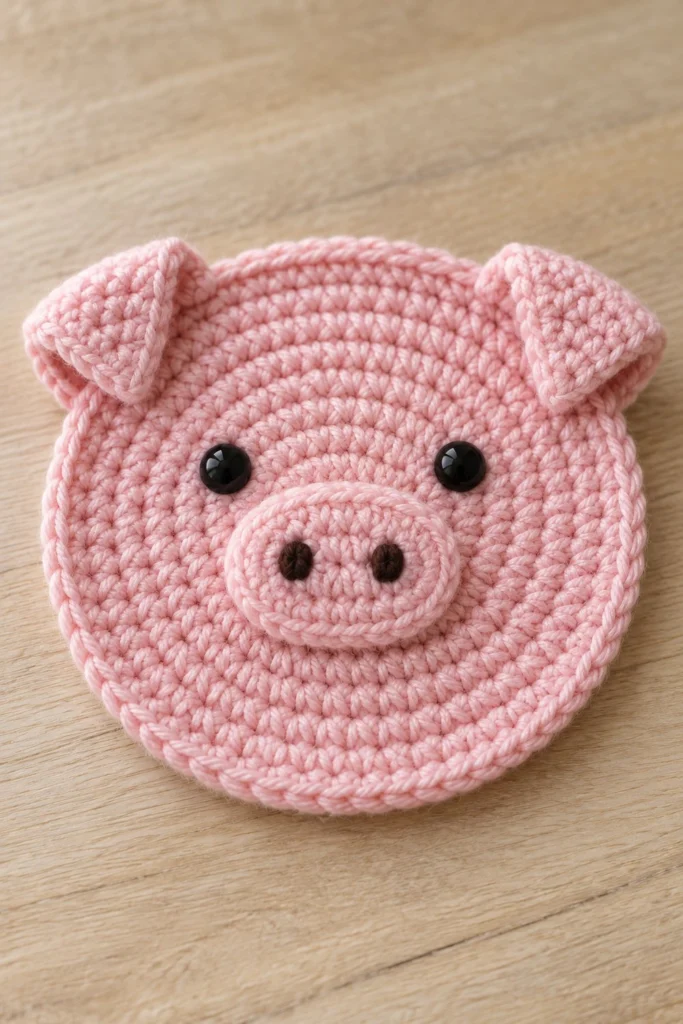
Bring a touch of handmade charm to your coffee table with this adorable crochet pig coaster! Featuring folded triangular ears, sweet pink cheeks, and an oval snout complete with two dark nostrils, this beginner-friendly design is as fun to make as it is to use. Working up in just about 35 minutes, it is a quick and satisfying project for crafters of all skill levels.
Quick Facts
| Skill level | Finished size | Yarn | Hook | Time |
|---|---|---|---|---|
| Beginner | 4 in / 10 cm diameter | DK cotton (Cat. 3) | 3.5 mm (US E/4) | 35 minutes |
Materials You Will Need
- DK weight 100% cotton yarn: 20 grams (approx. 50 metres) of Pastel Pink (Color A), 3 grams (approx. 8 metres) of Dark Pink (Color B), and a few yards of Dark Brown or Black for embroidery
- 3.5 mm (US E/4) crochet hook
- Two 6 mm black safety eyes (optional; can be embroidered instead)
- Tapestry needle
- Scissors
- Stitch marker
Gauge
The first 3 rounds of the Coaster Base should measure approximately 4 cm across. Working with even tension matters more than exact gauge for this project.
Abbreviations (US Terms)
- ch = chain
- sl st = slip stitch
- sc = single crochet
- hdc = half double crochet
- dc = double crochet
- inc = increase (work 2 sc in the same stitch)
- dec = decrease (work 2 sc together)
- BLO = back loop only
- st / sts = stitch / stitches
- Rnd / Rnds = round / rounds
UK terms: sc = dc, hdc = htr, dc = tr.
Pattern Notes
- The coaster base and snout are worked in continuous spiral rounds without joining, unless otherwise specified. Use a stitch marker to keep track of the first stitch of each round.
- Stitch counts are given in brackets at the end of every round or row.
- Ensure your tension remains consistent so the coaster lies completely flat.
Instructions
Coaster Base – Pastel Pink, make 1
Rnd 1: 6 sc in a magic ring (6)
Rnd 2: inc x 6 (12)
Rnd 3: (sc in next st, inc) x 6 (18)
Rnd 4: (sc in next 2 sts, inc) x 6 (24)
Rnd 5: (sc in next 3 sts, inc) x 6 (30)
Rnd 6: (sc in next 4 sts, inc) x 6 (36)
Rnd 7: (sc in next 5 sts, inc) x 6 (42)
Rnd 8: (sc in next 6 sts, inc) x 6 (48)
Rnd 9: sc in each st around (48)
Fasten off invisibly, leave a 30 cm tail for weaving and securing.
Snout – Dark Pink, make 1
Rnd 1: Ch 4, working in second ch from hook, work 2 sc in same ch, sc in next ch, 4 sc in last ch, rotate to work along opposite side of foundation chain, sc in next ch, 2 sc in last ch (10)
Rnd 2: inc in first 2 sts, sc in next st, inc in next 4 sts, sc in next st, inc in last 2 sts (18)
Fasten off, leave a 20 cm tail for sewing.
Ears – Pastel Pink, make 2
Row 1: Ch 5, working in second ch from hook, sc in each ch across, turn (4)
Row 2: ch 1, dec, dec, turn (2)
Row 3: ch 1, dec (1)
Fasten off, leave a 20 cm tail for sewing.
Assembly
Position the snout in the center of the coaster base, aligning it between Rnds 3 and 7. Sew it down securely using the dark pink tail. Insert the 6 mm safety eyes just above the snout, about 4 stitches apart, and secure the backs. Alternatively, embroider small French knots or simple straight stitches for the eyes using dark brown yarn. Fold the bottom edge of each triangular ear slightly to create a natural fold, then sew the ears to the top rim of the coaster base on Rnd 9, spaced about 6 stitches apart. Using dark brown yarn, embroider two vertical dark nostril lines onto the snout and a small happy smile just beneath it.
Finishing
Weave in all remaining yarn ends securely on the wrong side of the work. Block lightly with a steam iron or damp cloth if needed to ensure the coaster lies completely flat.
Tip: If you plan to use these coasters daily for hot mugs, use 100% mercerized cotton yarn so it absorbs moisture well and resists pilling.
Tips and Common Mistakes
- Curling edges usually mean your stitches are too tight; try going up a hook size if your base starts to cup like a bowl.
- Always secure safety eye backs firmly, or embroider the eyes if making this for a young child.
- Keep the snout small and centered so it does not interfere with the placement of cups and mugs.
- Count your stitches at the end of each round to avoid accidentally adding or losing stitches.
Frequently Asked Questions
Can I use acrylic yarn instead of cotton?
Yes, you can use acrylic yarn, but cotton is recommended because it is more absorbent, holds its flat shape better, and handles heat from mugs more effectively.
Are safety eyes safe for young children?
Safety eyes can pose a choking hazard for children under three years old. For items intended for young children, embroider the eyes using black yarn or embroidery floss instead.
How do I clean my crochet coasters?
Hand wash them gently in warm water with mild soap, lay flat to dry, and reshape while damp.
Can I make this coaster larger?
Yes, you can continue the circular increase pattern by adding more rounds (e.g., working 7 sc and an increase in the next round), though you may need to adjust your yarn amount.
📄 Your free PDF pattern